Published Last updated
CISA added CVE-2026-115731 in Perforce Puppet Enterprise to its Known Exploited Vulnerabilities (KEV) catalog on November 17, 2026. The entry describes a report-processing deserialization flaw that can let a client with any certificate signed by the Puppet certificate authority run arbitrary code on Puppet Server as its service user. CISA lists December 1, 2026 as the catalog due date and directs covered stakeholders to apply vendor mitigations under Binding Operational Directive (BOD) 26-04. That date is a catalog action date, not the date of Perforce’s patch release and not a universal deadline for every Puppet deployment.
How the report-processing flaw works
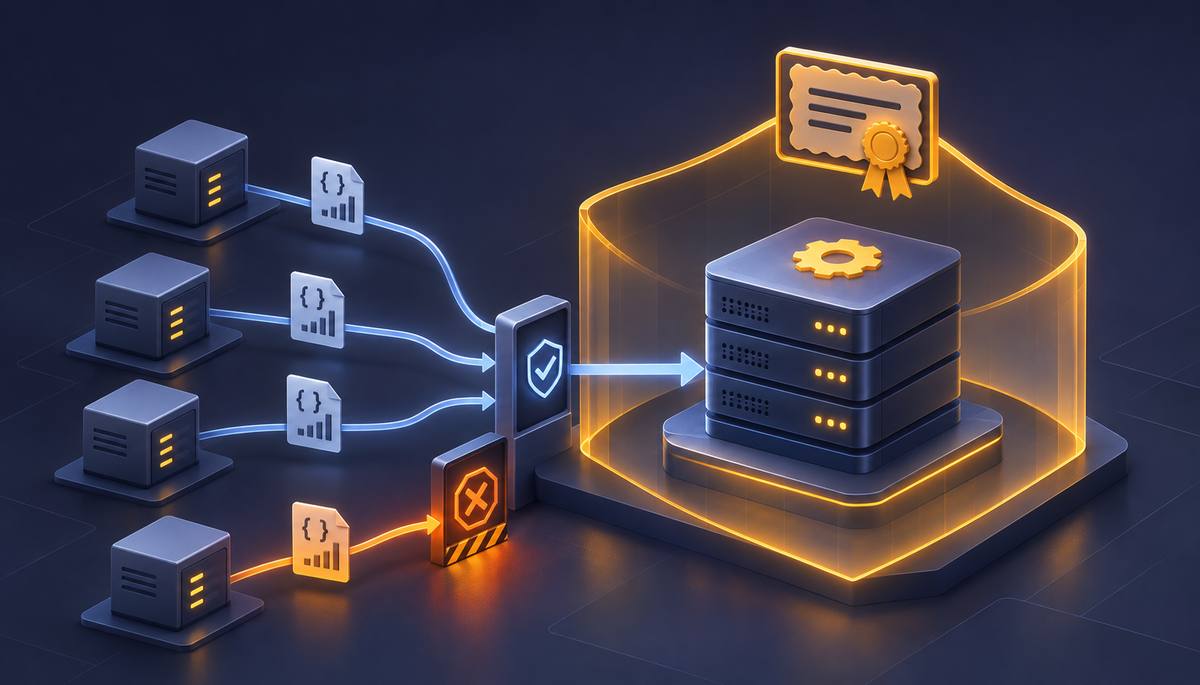
Puppet agents report the results of configuration runs to a primary Puppet Server. Those reports are part of the product’s ordinary management traffic: they carry resource status, events, messages and metrics. CISA says CVE-2026-115731 sits in the server’s report-processing code. A client holding any CA-signed agent certificate can submit a report containing a crafted rich-data type through a PUT request. The vulnerable processing path can then execute code on Puppet Server under the service account. This is a server-side trust boundary; the affected operation is more consequential than a malformed report being displayed incorrectly.
The certificate requirement needs careful reading. CISA does not say that every unauthenticated internet client can directly exploit a normally configured server. It says a client with any certificate signed by the Puppet CA can use the path. CISA also warns that, if a certificate authority automatically signs requests without strong verification, an unauthenticated network attacker may obtain a valid certificate and then exploit it. The practical exposure review therefore has two parts: who can reach the report endpoint, and how agent certificates are issued and controlled. Merely noting that mutual TLS is present does not settle the risk described by the catalog entry.
CISA’s KEV placement means it has added this CVE to a catalog of vulnerabilities known to be exploited. The public CSV does not identify a victim, an exploitation campaign, or a ransomware association for this entry; the ransomware field is “Unknown.” The available catalog text also does not establish that every deployment has the same network path or certificate-signing policy. Incident conclusions require evidence from the affected environment. The immediate reference change is the catalog addition and its listed action date.
Fixed Puppet Enterprise versions
Perforce’s Puppet release summary identifies Puppet Enterprise 2026.0.1, 2025.12.1 and 2023.8.13 as releases that fix CVE-2026-115731. It describes the flaw as report deserialization code execution on the Puppet Server host and rates it critical. The corresponding 2026.0.1, 2025.12.1 and 2023.8.13 release notes each list the CVE among their security fixes. These are Puppet Enterprise product versions; they should not be confused with the Puppet Server component version or with a DISA benchmark version.
The vendor documentation says these Enterprise fixes were released in November 2026. Its release-note pages have different “last published” dates, which are documentation timestamps rather than a precise common release day. CISA added the vulnerability to KEV on November 17. Treating the patch publication and KEV addition as separate events matters for an accurate change record: the fixed versions existed before the catalog acquired the action date.
Perforce also lists Puppet Core 9.1.3 and 8.22.1 as security updates addressing the same CVE. The Core 9.1.3 release notes say Puppet Server 9.0.24.1, shipped with Core 9.1.3, was patched. CISA’s KEV row names Puppet Enterprise specifically. Operators should use the vendor’s product-specific release notes to select a fixed build for the deployed edition instead of assuming that an Enterprise version number maps directly to a Core version number.
A second critical fix changes certificate-name matching
The same Puppet Enterprise updates also fix CVE-2026-115732, a separate certificate-name authorization bypass. Perforce says an agent could impersonate another machine when a certificate name only partly matched an approved name. The new auth.conf behavior is stricter: a hostname rule matches that exact hostname, and a wildcard such as *.example.com matches names below the domain but no longer matches the bare example.com name itself. Perforce’s release notes say to add a separate rule if the bare domain must remain allowed.
This companion fix is operationally relevant to the upgrade. Administrators who use wildcard certificate rules should inspect the intended names before rollout and test agent authorization afterward. A change that closes a name-matching bypass can also reveal a previously implicit allowance. CVE-2026-115732 is listed by the vendor as fixed in the same releases, but it is not the vulnerability added in CISA’s November 17 KEV row. The two identifiers should remain distinct in tickets, advisories and notices.
Support-stream and upgrade considerations
Perforce now describes Puppet Enterprise 2026 as its Latest stream and PE 2025 as Latest-1. The PE 2026.0.1 notes say the 2025 series continues to receive security updates, defect fixes and technical support. PE 2023.8 is the final legacy Long-Term Support series and is in an overlap support period that Perforce says ends February 27, 2027. Those lifecycle facts help explain why the three fixed Enterprise versions appear in different branches. They do not make February 2027 a remediation deadline for CVE-2026-115731.
An inventory should record the actual PE release, its support stream and the Puppet Server component that is running. A server on an older supported branch should be compared with the fixed patch for that branch. A server on a release that no longer receives maintenance needs an upgrade path into a supported fixed release. Perforce’s upgrade documentation should govern sequencing, backup and platform compatibility; the KEV row is not an installation guide. The vendor release notes also list related operational changes, including protection of Forge authorization tokens and removal of compromised eMudhra intermediates from bundled trust stores. Those changes may matter to an upgrade plan, but they are separate from the report deserialization flaw. The same release family also tightens file-upload path validation in the newer PE branches. Recording these as distinct fixes prevents an upgrade assessment from treating every included change as a prerequisite for exploiting CVE-2026-115731. The available public sources do not justify claiming that disabling reports is an equivalent vendor-approved fix.
What the KEV date requires and what it does not
The CISA CSV lists December 1, 2026 in its dueDate field for CVE-2026-115731. Its required-action text calls for vendor mitigations, evaluation of each asset’s internet exposure, and adherence to BOD 26-04 patching guidance. The catalog references separate BOD 26-04 and implementation-guidance pages for the exact federal requirements. The catalog date must not be recast as a vendor end-of-support date or a universal private-sector mandate. Teams subject to the directive should follow its current text and any applicable agency instructions; others can use the exploited-status signal to prioritize risk without mislabeling the obligation.
For affected Puppet Enterprise installations, the defensible sequence is to confirm product and version, review report-endpoint reachability and certificate issuance controls, identify the appropriate fixed release, and plan the change under the vendor’s upgrade guidance. After deployment, verify the running PE and Puppet Server versions and test ordinary agent reporting and authorization, especially where auth.conf wildcard rules are used. Where exploitation is suspected, preserve and review relevant server and certificate-authority evidence under the applicable incident process. A successful upgrade establishes the installed fix; it does not by itself determine whether a report was previously abused.
The primary public records are the CISA KEV CSV for the November 17 addition and catalog date, and Perforce’s Puppet Enterprise release summary with the individual release notes for fixed builds and behavior changes.